

Butch Cassidy in Telluride: The Bank Robbery Behind Robbers Roost
Long before Telluride became known for world-class skiing, summer festivals and luxury mountain homes, it was a remote mining town where fortunes could appear—and disappear—almost overnight. The streets were crowded with miners, merchants, cowboys and prospectors. Saloons outnumbered churches, money moved through town in large quantities and the surrounding mountains made Telluride feel like a world unto itself.

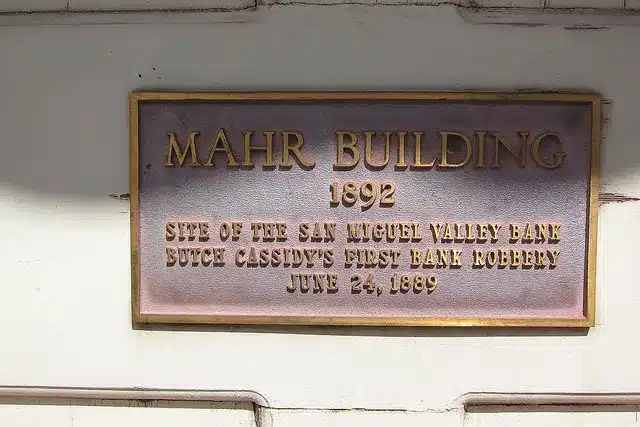
On June 24, 1889, Robert LeRoy Parker—better known today as Butch Cassidy—and three accomplices robbed the San Miguel Valley Bank in Telluride. The crime is widely regarded as Cassidy’s first major bank robbery and the moment that helped launch one of the most famous outlaw careers in the American West.
More than 135 years later, Butch Cassidy’s Telluride history still feels remarkably close. Visitors can walk past the site of the former bank, follow the valley the robbers used to escape and explore a town where much of the original mining-era character remains intact. There is even a private residence in Mountain Village that holds an extraordinary connection to the story: a restored 1800s pool-hall bar reportedly used by Cassidy shortly before the robbery.
That home is appropriately named Robbers Roost.
Telluride in 1889: A Mining Town on the Edge
To understand why Butch Cassidy came to Telluride, it helps to understand the town he encountered.
Telluride had been incorporated for only a little more than a decade. Mining camps and settlements had formed throughout the San Juan Mountains following discoveries of gold and silver, and the local economy grew rapidly as mines expanded above the valley. Ore, payroll money, supplies and workers all passed through town.
The Telluride Historical Museum has described the community of 1889 as a place with ten saloons and no church. Miners and cowboys mixed with gamblers, rustlers, merchants and lawmen. The town’s isolation made it difficult to reach, but mining wealth made it worth the journey.
The landscape shaped daily life. Telluride sits in a narrow box canyon surrounded by steep peaks, with only a few practical routes into or out of the valley. In winter, snow could make travel punishing. In summer, the same roads and trails carried mining equipment, stagecoaches, horses and growing amounts of cash.
For the San Miguel Valley Bank, that cash included deposits and mining payrolls. For Cassidy and his associates, it represented opportunity.

Photo courtesy of Telluride Historical Museum
Who Was Butch Cassidy Before Telluride?
Butch Cassidy was born Robert LeRoy Parker in Beaver, Utah, in 1866. He grew up in a large family and worked as a ranch hand during his youth. By his early twenties, he had begun drifting between ranching work, horse theft and the loosely defined outlaw world of the late 19th-century West.
The polished, almost friendly image later associated with Cassidy can make it easy to forget what a bank robbery involved. He may have developed a reputation for careful planning and personal charm, but he was still willing to use the threat of violence to steal money and evade law enforcement.
When Cassidy arrived in Telluride in 1889, he was approximately 23 years old. He was not yet the nationally known leader of the Wild Bunch. He had no Hollywood film attached to his name, no famous partnership with the Sundance Kid and no established place in American folklore.
The Telluride robbery helped change that.
The Name Behind the Legend
Robert Parker reportedly adopted the name “Butch Cassidy” during his early years in the West. The surname is generally associated with Mike Cassidy, a cowboy and rustler who influenced him, while “Butch” has often been linked to Parker’s time working as a butcher.
Like many details in Cassidy’s life, the precise origin has been repeated in several versions. That uncertainty is part of the challenge of separating the historical man from the legend. Newspaper reports, memoirs and later retellings do not always agree. What is firmly established is that the name Butch Cassidy would soon become known far beyond Telluride.
The San Miguel Valley Bank Robbery
The Library of Congress dates the robbery to June 24, 1889, and identifies Cassidy and three other men as the participants. Accounts generally connect Matt Warner and members of the McCarty family to the crime, although some details vary among historical sources.
The robbers had reportedly studied the bank and the rhythms of the town before making their move. The San Miguel Valley Bank stood on Colorado Avenue, the commercial heart of Telluride. Once the opportunity presented itself, members of the group entered the bank, threatened the employee inside and gathered the available money while horses waited nearby.
The amount stolen is usually reported at roughly $20,000 to $21,000—a substantial fortune in 1889. Exact totals differ among accounts, but there is no disagreement that the robbery was a major score.
Later retellings describe the men riding away at speed, shouting and firing their revolvers as they left town. Historical accounts also suggest that the telegraph line had been cut, delaying communication with communities down the valley. By the time a posse organized, the robbers already had a valuable head start.
The Escape From Telluride
Telluride’s geography made the getaway both difficult and strategically useful. The same mountains that limited travel also offered numerous places to disappear. A historical marker near Telluride describes the group traveling over Lizard Head Pass, hiding around Mancos Mountain and eventually making its way toward the remote canyon country of southeastern Utah.
A posse pursued the robbers but failed to capture them. According to later accounts, the men were identified during their escape by someone familiar with them, transforming the robbery from an anonymous crime into a turning point in Cassidy’s life.
Matt Warner later described the episode as the moment the men crossed fully into outlaw life. Whether every dramatic detail has survived intact is difficult to prove, but the larger point is clear: after Telluride, Robert Parker was no longer simply a wandering ranch hand with a questionable past. He was a wanted bank robber.
From Telluride to the Wild Bunch
The San Miguel Valley Bank robbery did not immediately create the Wild Bunch as most people recognize it today, but it established a pattern Cassidy would refine: preparation, fast horses, remote escape routes and trusted associates.
During the 1890s, Cassidy became connected with a shifting group of outlaws involved in bank and train robberies across the West. The group later known as the Wild Bunch included Harry Longabaugh—the Sundance Kid—along with figures such as Elzy Lay, Harvey Logan and Ben Kilpatrick.
Cassidy’s reputation grew partly because of the scale and audacity of the crimes and partly because of the persona that formed around him. He was often depicted as a courteous outlaw who preferred planning over bloodshed. That image has endured in books, films and popular culture, although it should not obscure the very real fear and danger created by armed robberies.
Robbers Roost: The Outlaw Hideout
One of the locations most closely associated with Cassidy and the Wild Bunch was Robbers Roost, an isolated area of canyon country in southeastern Utah. Its cliffs, ravines and limited approaches made it difficult for outsiders to enter without being noticed. Outlaws could rest, replace horses, obtain supplies and wait for attention surrounding a robbery to fade.
The landscape was not a single secret cave, as it is sometimes imagined, but a broad and forbidding region that offered natural protection. For lawmen unfamiliar with the terrain, pursuit could be dangerous and ineffective. For Cassidy and his associates, it became part hideout and part symbol of independence from the outside world.
The name would eventually find its way back to the Telluride region in an unexpected form.
Where Butch Cassidy’s Telluride History Meets Robbers Roost
At 176 Butch Cassidy Drive in Mountain Village, a private estate named Robbers Roost carries the story into the present. The connection begins with the address and the name, but its most compelling link to Cassidy sits inside the house.
According to the property’s provenance and a recent Forbes feature, the home contains the restored bar from an old Telluride pool hall where Cassidy reportedly stopped before robbing the San Miguel Valley Bank.
The story is that Cassidy took his final dose of courage at the bar while watching the bank across the street. As with many colorful details surrounding Cassidy, that moment is best understood as reported local history rather than a conclusively documented fact. The bar itself, however, is an authentic 1800s Telluride artifact—and its presence inside the home creates a physical connection to the era that inspired the residence.
Today, the bar anchors an intimate television lounge. It is not displayed behind museum glass. It remains what a bar has always been: a gathering place for conversation, storytelling and a drink at the end of the day.

Robbers Roost at dusk. Photo: Virginia Bender / Telluride Properties, as featured by Forbes.
A Modern Interpretation of the Old West
Robbers Roost was designed by ONE Architects and built by Overly Construction. The approximately 10,490-square-foot residence sits on 1.89 private acres among mature aspen and spruce, with views toward the San Sophia Ridge and excellent ski access.
Its architecture draws from the working buildings of the rural West rather than attempting to recreate a saloon or mining camp. Reclaimed Douglas fir timbers, wide-plank oak floors, natural stone and custom alder cabinetry give the home warmth and substance. Exposed beams, patinated metal and barnlike volumes reference the region’s mining and ranching history with a refined, contemporary hand.
The vaulted great room centers on a dramatic two-sided stone fireplace shared with the kitchen and dining areas. Expansive glass doors open to a covered deck, allowing the house to shift naturally between indoor gathering spaces and the surrounding forest.
Built for Family, Guests and Every Season
The residence includes six bedrooms, six full baths and two half baths. Two primary suites and multiple guest suites make it well suited for extended families or groups of friends, while a separate one-bedroom guest residence above the heated three-car garage provides additional privacy.
Beyond the historic bar, the home includes a private office, theater, game room, wine room and ski mudroom. Seven gas fireplaces create warmth throughout the residence, and the chef’s kitchen and large dining space are designed for the kind of gatherings that define a multigenerational mountain home.
Winter brings easy access to skiing. Summer opens the door to hiking, biking, golf and Telluride’s festival season. In fall, the surrounding aspens turn the property gold. Despite its private forested setting, the home remains convenient to Mountain Village and Telluride.
Why the Story Matters
Telluride luxury real estate is filled with beautiful architecture, exceptional views and access to the outdoors. What cannot be newly built is authentic local history.
Robbers Roost stands on its own as an impressive mountain residence, but the historic bar gives it a story rooted in a specific time and place. It connects a modern home to the rough mining town that existed before the ski resort, the gondola and the festivals. It also creates a natural link between two very different versions of Telluride: the frontier community of 1889 and the refined mountain destination of today.
That connection helped attract national attention from Forbes, which featured the property as a place where Butch Cassidy meets Colorado sunsets. The description works because the history is not merely decorative. The address, the home’s name, its Western materials and the restored pool-hall bar all reinforce the same narrative.
Tracing Butch Cassidy’s History in Telluride Today
Visitors interested in Cassidy can still explore the story around town. The Telluride Historical Museum offers resources and walking-tour information covering the community’s mining years, lawmen and outlaws. The site of the San Miguel Valley Bank can also be visited along Colorado Avenue, where a plaque recalls the 1889 robbery.
Standing there, it is easy to appreciate how close the story remains. Telluride has changed dramatically, but the scale of the town, the surrounding peaks and the route down the valley are still recognizable. The landscape that shaped the robbery continues to shape life here.
For me, that is what makes Butch Cassidy’s Telluride history so compelling. It is not an abstract Western tale that happened somewhere beyond the horizon. It began on a street we still walk, beneath mountains we still see every day.
And at Robbers Roost, one surviving piece of that era has found a remarkable home.
Explore Robbers Roost at 176 Butch Cassidy Drive
Robbers Roost is offered at $19,500,000 through Telluride Properties. The estate combines privacy, ski access, San Sophia Ridge views and finely executed mountain architecture with one of the most distinctive historical connections in the Telluride market.